I Wrote a Complaint. Then I Built a Product. As One Does.
Part two of the shared-link problem. The original complaint turned out to be the last link in a chain that was broken upstream. I'm a founder now. Yee-haw.
By Marc Hanson••
#ai#productivity#startups#knowledge-management#tidbiits
•
Where We Left Off
A couple of months ago I griped about how sharing content with my team had become a black box. I'd find a great forty-seven-minute video, drop it in Slack, it would sit there unwatched, eventually purged along with the rest of the bookmark graveyard. The bookmark told nobody anything. Not the shape. Not the payoff. Not whether to watch ten minutes or clear an afternoon. The best I could do was throw URLs over the wall and make a little prayer that this time would be different. It was never different.
That post ended without a tidy answer. I said maybe it was better tools, maybe better habits, maybe just accepting that links were never going to carry the weight of real knowledge transfer. Three months later I want to come back to the question. The problem kept frustrating me, and I got sick of listening to myself complain about it. We decided to build something for our team. OPERATION: WATCH THE DAMN VIDEO. Our whole relationship with content needed an overhaul in 2026.
I Was Only Describing the Last Leg
The more I thought about my blog post from January, the more I realized I had only captured the last link in a chain that was broken end to end. Sharing is the visible part because Slack messages going unwatched are loud. Trying to start a conversation with a coworker about that thing you sent yesterday gets awkward fast when they "forgot to look at it" and would like to steer the discussion to another topic. But the sharing stage is just where the problem becomes other people's business. The problem starts upstream.
Consuming content alone in 2026 is expensive. And there is so much content it can feel like drowning to try and keep up. Even when nobody else is involved, I stare at a ninety-minute talk and do the math. Do I get thirty minutes of value out of this? Fifteen? Any? A lot of the time the rational move is to skip. Not because I don't want the insight. Because the link isn't willing to tell me what I'd be trading my time for, and I can't be the one spending that currency every time.
Reasoning alone is harder than it should be. Assume I actually watch the video. What the heck do I do now? Hold it in my head? Take notes in Google Docs or some other note taking app? Trust my memory? A month later I couldn't tell you what the insight was if you put money on it. I'm sure I learned something. That something is in a drawer somewhere. I might have to go back and re-consume the content to really refresh things.
Sharing is the part I already complained about. Now I see it sits at the end of a chain that was already pretty inefficient. By the time I'm pasting the URL in Slack I've already paid the consumption cost alone, failed to capture it alone, and wandered off. No wonder the share fails too. Nothing behind it survived either.
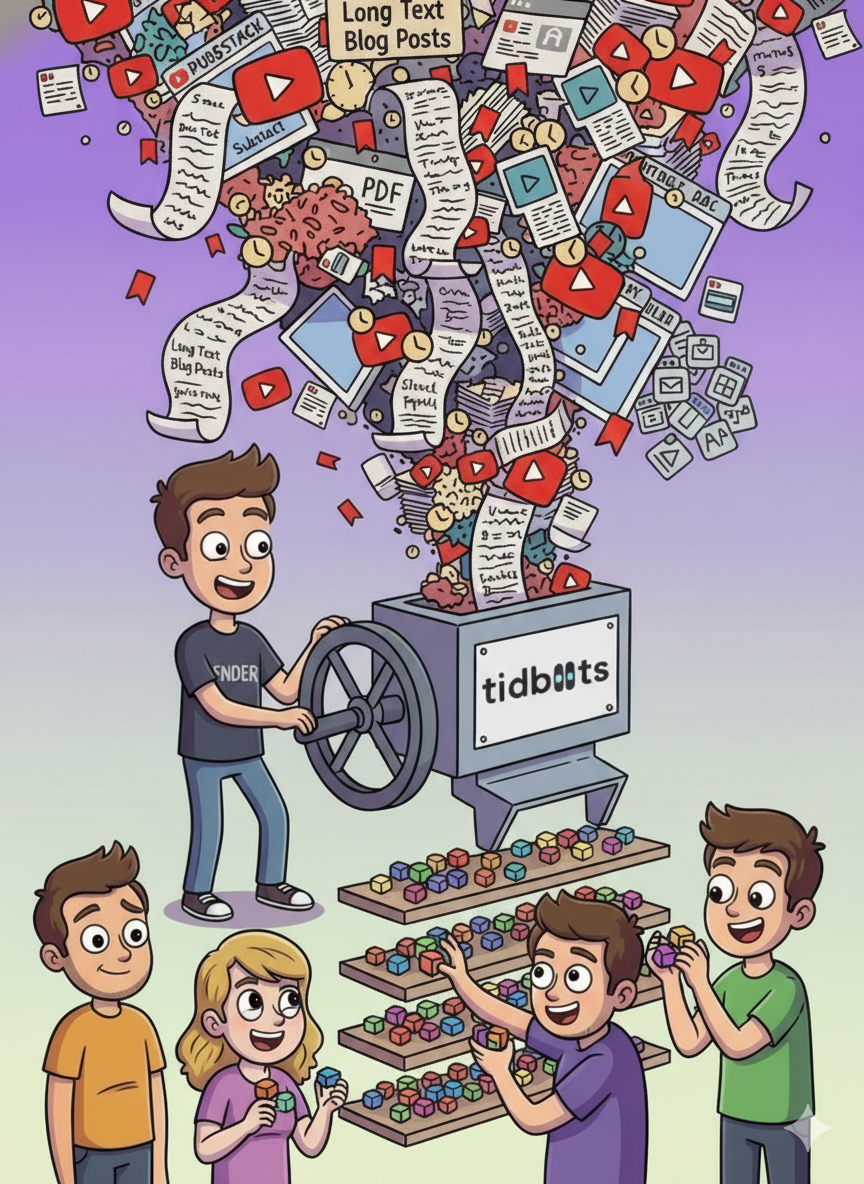
I originally griped about YouTube, but this is a multi-modal grievance. Ninety-page PDFs dropped in Slack. Forty-paragraph Substack posts. X threads that are secretly twelve hundred words with vibes. Google Docs someone spent a week on that nobody will open. Conference talks, podcasts, investor letters, internal post-mortems. Blah blah freaking blah. The black box is a content-format problem, not a YouTube problem.
The Real Cost
There are two costs, both costlier than I realized originally.
The first is that I skip things. A lot. When the cost of consuming is "twenty minutes I might not get back," skipping is rational. I try to avoid "wasting cycles" for low or no value. But that means I skip the genuinely good stuff right alongside the chaff. Multiply that across a week and I am visibly not learning the things I keep telling myself I'll learn. My finite brain cycles are too valuable to spend on a coin flip. The black box doesn't only cost my teammates when I chuck links at them. It costs me. I'm declining to invest in my own orientation because nothing about the link tells me what the investment is.
The second is fragmented team intelligence. Everyone consumes or doesn't in isolation. Insights die quietly in one person's head. Three months later nobody can find "that key thing about X," including the person who originally found it. Onboarding a new person to a topic means pointing them at the stale Notion doc nobody has opened voluntarily since 2023 and wishing them luck. And patterns across sources, the thing where a post from last Tuesday, a talk from December, and a document from some CTO all describe the same dynamic, stay invisible because nobody is connecting them.
The first cost is what got me building. The second is what made me certain we were on to something we'd really use.
What I Actually Wanted
Feel caught up, not drowning
Stop pretending I watched it
Learn without losing the afternoon
Content stops feeling like homework
Share without the "sorry it's long" preface
Know what my team is actually thinking about
Piggyback on what my teammates already read
My library gets more valuable over time, not less
I described this in Part 1 but it's worth pulling forward. I wanted a map, not a ride. Given a piece of content, show me the shape first. What are the main topics? Where does the signal sit? Let me see the structure before I commit. Let me drill down on the parts I care about and skip the ten-minute preamble the creator insists on delivering. Curation instead of summarization. A summary replaces the original. A map indexes it and points at which three minutes are worth the oxygen.
What I didn't push hard enough on in Part 1 is what the map needs to do after it exists. It has to be shareable, so my team gets the map instead of a link to the thing they'd need to re-do the work on. That saves the consumption cycles for each subsequent team member. It has to be persistent, so I can come back in a month when I've completely forgotten what was in that article and still orient without re-consuming anything. And it has to be composable, so when I've built fifty maps they add up to something instead of sitting around as fifty orphan artifacts wondering why nobody loves them and when Daddy is coming home from buying cigarettes.
So We Built It: tidbiits
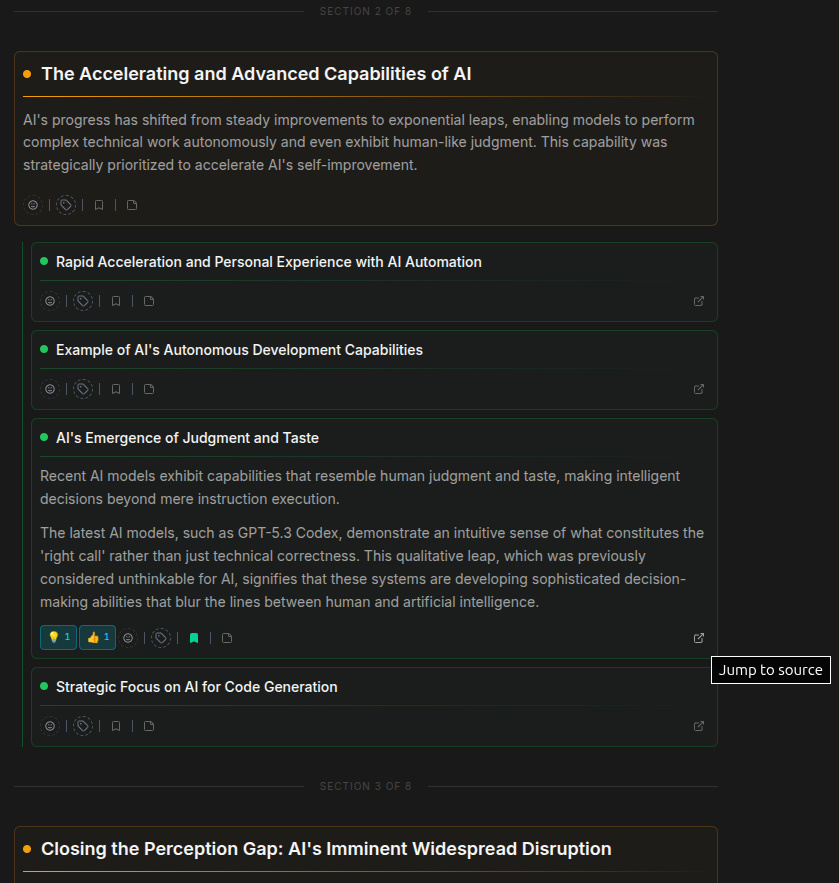
Here is the shortest version. Drop in a webpage, article, PDF, YouTube video, Google Doc, social thread, or raw text. What comes back is a tidbiit. That's our word for it. It's also the name of the product. We spent a lot of time on branding. It's the map I described above, made concrete. A synopsis at the top tells you what the thing is in a paragraph or two. If the content is unappealing at paragraph resolution, congratulations, I just saved you an afternoon. If it appears plausibly valuable, the topics and groupings below give you the shape of the content and let you jump straight to the parts worth your time. Drill-downs inside each group have the actual details at whatever depth you want. Links back to the timestamp, paragraph, or passage in the source let us go as deep as the content deserves.
You see the shape. You go deep where it matters. The source is one click away. When you share the tidbiit with your team, they get the map too. Not a black-box URL, and not a vague appeal to their goodwill. Only one person has to spend the mental currency to evaluate it. Everyone else jumps straight to the signal.
One Tidbiit Is Nice. Fifty Is a Library You Can Reason About.
A single tidbiit solves the consumption problem. But after we built up a library of them a new problem arrived with the mail. How do we recall and reason across all of it? Bookmarks don't help. Browser tabs don't help. My memory doesn't even pretend to help anymore.
This is where the tidbiits start to compound. Search becomes semantic, so I can ask my library for "that thing about pricing pressure in mid-market B2B" and find it even if those exact words aren't in any title. I can chat with the whole library instead of one document at a time and get answers pulled from everything the team has ever ingested, with citations back to the specific tidbiits the answer came from. I can pick a handful of topics and ask the system to pull together what's been said about them across sources. Patterns, overlaps, contradictions I wouldn't spot on my own and certainly wouldn't go hunting for. The system also quietly extracts topics and themes across the whole library, so I can see what my team has actually been thinking about over the last few weeks without having to ask anyone.
A single piece of content stops being a thing I read once and forget and becomes a node in something I can revisit and reason about months later. That part changed how I relate to content more than the per-document summary did.
The Team Layer
Recall and reasoning are already useful solo. The team layer is what turns it into something the whole crew can actually use. Annotations happen in context, so discussion lives where the idea lives, instead of in a Slack thread a week away from the thing being discussed. Insights get captured as you read, either as action items or as observations worth preserving, and you can push them to Linear with one click so the learning occasionally turns into work. The knowledge base is shared. Every tidbiit and every annotation is something the team can find later, not just the person who happened to ingest it first and then moved on to the next shiny thing.
Making Re-orientation a Daily Habit
There's a reason I care about this more than a normal reader would. Teams that systematically update their collective orientation, what John Boyd would call the second O in OODA, have a structural advantage. They notice things earlier. They disagree less about reality.
The problem is that most "knowledge management" tools end up as graveyards with nice lighting. You visit during onboarding, say you'll come back, don't. The tool knows everything. Nobody looks at the tool. The tool is sad about this.
We built tidbiits for ourselves first, as a tool that lives in the daily loop instead of one we pretend to use. The activity feed is an inbox. New ingestions, annotations, @mentions, and insights show up alongside the rest of your work. Checking it is the same kind of habit as checking Slack or email, not a quarterly offsite exercise run by a consultant. I can see what's been added in the last day or two, who starred what, where discussion is happening, and how it ties into the rest of what we've ingested.
Because tidbiits exposes itself through an MCP server (the thing that lets your AI assistant talk to other apps), I take it further, right from my editor. Most mornings I ask Claude something like "summarize the hot topics on the team the last three days, include any discussions and starred concepts, and tell me whether any of it touches my current project." What comes back is closer to a briefing than a list of links. It tells me which new ingestions are likely to matter, which conversations are worth reading, and where the team's attention overlaps with mine. Five minutes and I'm oriented for the day without opening a single tab. All the benefit of content consumption with almost none of the losing-the-afternoon-to-a-rabbit-hole part.
The goal (for us, anyway) is constant, lightweight re-orientation. What did the team learn today. What's worth reacting to. What becomes an action.
No Tidy Ending, Again
I ended Part 1 without a tidy ending. We now have a version of an ending. It's not a bow. tidbiits solves a real problem we were having individually and as a team. It's early and there are rough edges, and as our libraries mature we'll definitely discover new reasons this was harder than we thought. But we're collaborating and consuming more efficiently, and it's become part of the daily routine instead of a disruption we resent when we're trying to actually get something done.
What I can say is that the specific thing I wrote about in January, the forty-seven-minute video dropped into Slack followed by a week of silence and an awkward reference I couldn't back up, happens a lot less often now. When I find something good I ingest it, make a tidbiit, and start a discussion with something other than "trust me." My teammates actually engage with it. The original link is still in there, one click away, if they want to go super deep.
There's a real chance both this post and Part 1 end up in someone's bookmark folder and get purged in six months. I will have thoughts about that. But if the problem I'm describing sounds like one you also have, come try tidbiits and tell us what's broken. We'd rather hear about the parts we got wrong than the parts we got right.
Marc Hanson is a co-founder at Super Mega Lab and is still regularly enrolled at YouTube University.