Why Doesn't Anyone Watch the YouTube Videos I Share?
Personal musings on attention, curation, and sharing in the modern content fire hose.
By Marc Hanson••
The Problem I Keep Encountering
Confession: I watch YouTube a lot. I mean A LOT a lot. I have it running on a side monitor most of the day, hoping to extract from the endless fire hose of content the golden nuggets of insight and learnings that will help me grow. My tuition bill at YouTube University would be astronomical.
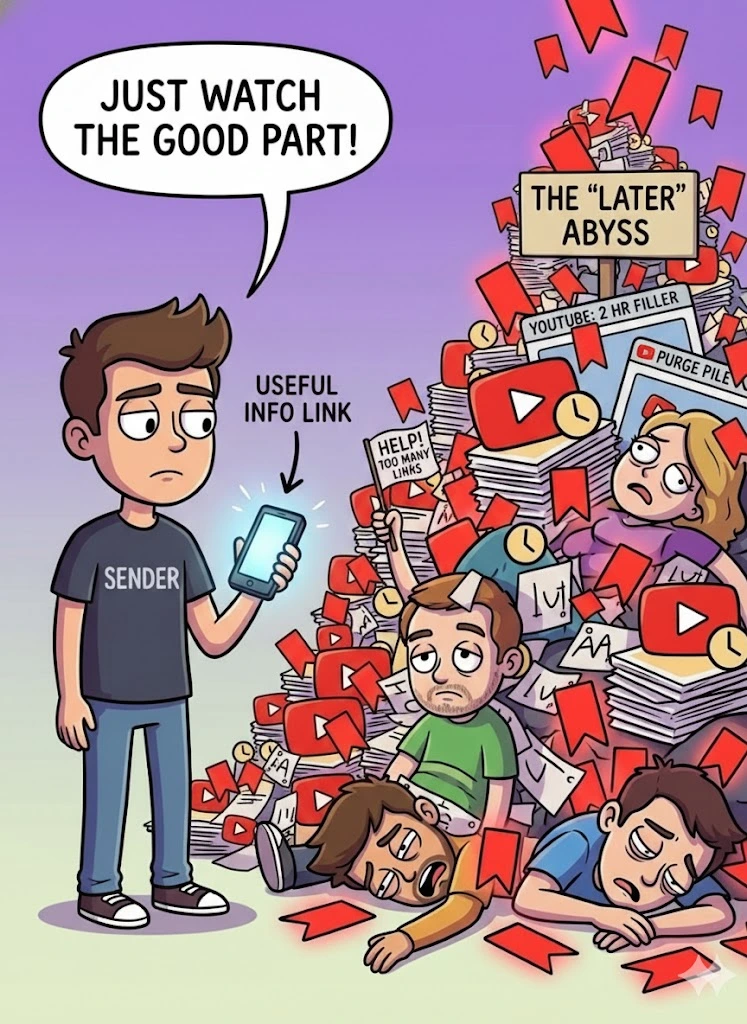
There's a pattern I've noticed for years. I think it's a problem, and one that's exploded recently. I find a video containing content that alters how I think about something. Perhaps forty-seven minutes of a practitioner sharing hard-won lessons. Real experience, not theory. The good stuff. I drop it in Slack. "This video is great! Worth watching." A week later I reference something from the video. The response? "Yeah, I haven't had time to watch that yet." Of course, it's been just long enough that I can't quite remember which part of the video was the key insight, so I'm not that much help.
My teammates aren't lazy. But I asked them to invest forty-seven minutes based on my two-word review. The chance that the entire video is worthwhile is very low. They've been burned before. Who hasn't sat through thirty-eight minutes of preamble in a video to get to a four-minute insight that could've been an email on multiple occasions? I have! The link sits in their bookmarks. Eventually it gets buried. One day it gets purged when they realize the folder is unsalvageable. I've done this to people too. Someone shares a link with me but I'm busy. I bookmark it with genuine intentions to watch it "tonight". I never go back. The bookmark tells me nothing about whether I need to watch ten minutes or the entire thing, or whether the good part is at the beginning or buried at minute thirty-four.
The link is a black box. Black boxes don't get opened when you're already drowning.
The Typical Life Cycle of a Shared YouTube Link
Find something great
"This is great!"
"This is pretty long, I'll watch it later."
Bookmarked with good intentions
Purged months later
Up to 47 minutes of value. Zero knowledge transferred.
The Forty-Five-Minute Fifteen-Minute Video
There's a version of a hypothetical YouTube talk in 2019. It's fifteen minutes long. The speaker gets to the point, makes it, sits down. Tight. Respectful. Value per minute consistent and high. The 2026 version of the same talk is forty-five minutes long. Same fifteen minutes of insight, maybe, but now there's a ten-minute preamble, two sponsor segments, digressions that go nowhere, and a recap of the recap.
The Same Talk, Seven Years Apart
201915 min
All Signal
202645 min
Preamble
Ads
The Insight
Filler
Recap
Same insight. Triple the runtime.
What happened? The incentives shifted or at least seem to have amplified. In an attention economy when your revenue comes from watch time, you optimize for watch time. The viewer's benefit becomes secondary. I love using AI, but the same AI technology that helps someone communicate clearly can also help them turn a ten-minute insight into a bloated forty-five-minute video if that's what the metrics reward. In the olden days of the newspaper, editors would cut down content length for maximum impact. Column space was at a premium. I feel that function got replaced largely by dashboards showing average view duration with more being better.
The Joker (1989) said "This town needs an enema!"
In 2026, the content needs an enema.
The Trust Gap
When I share a link, I'm asking someone to trust me with their time. But the link communicates nothing about why that trust is warranted. A YouTube URL says: here's somewhere between three minutes and three hours of something. Good luck. Since videos that are all-signal no-noise are rare, sharing carries a significant potential of wasted time and attention.
Sharing works a little better if I do extra labor:
"Skip to 12:30-18:00. That's the architecture decision."
"First ten minutes are skippable. Start at the demo. The last ten minutes is redundant."
And so on.
What Happens When You Share a Link
Without context
Share link
Black box
Bookmarked
Buried
Purged
With context
"Skip to 12:30"
Known investment
Actually watched
The more pre-filtering work I do, the greater chance of engagement with the info I shared. But it's tedious.
What I Actually Want
I want to consume things drill-down style. Give me the shape first. What are the main topics? Let me see the structure before I commit. Sometimes video chapters help with this, but some content creators grew wise to this and make 100 chapters in a video where the chapters don't really align with the content very well, causing an attention hostage situation.
Linear (how it is)
1Intro you don't need
2Context you have
3The actual insight← the good part
4Recap of what you just heard
You sit through everything to find the signal.
Drill-down (what I want)
Overview first:
Topic 1 Topic 2 Topic 3 ←Topic 4
Topic 3 (expanded)
• Key point A
• Key point B
→ Jump to 12:34 in source
See the shape. Go deep where it matters.
After the shape, let me choose depth. Topic four looks relevant, I'll dig in there. There's a claim at minute thirty-four? Let me hear that in context. The rest I'll skip. Most content is linear. You start at the beginning, proceed to the end, creator controls pacing. I don't want a ride. I want a map with points of interest marked.
When I share with my team, I want to share that map. Here's the structure. Here are the parts that matter. Here are my thoughts and what I learned from it. Now engage at whatever depth makes sense for you.
That's curation. Not summarization. A summary replaces the original. Curation indexes it. The path back to the source stays open.
No Tidy Ending
The gap between "I found something valuable" and "my teammate has that value too" is wider than it should be. The signal-to-noise ratio keeps getting worse, which makes everyone more protective of their attention, which makes sharing harder. Maybe the answer is better tools. Maybe it's better habits. Maybe it's accepting that links were never going to carry the weight of real knowledge transfer. Maybe YouTube will cease to be a great platform for learning eventually. But I keep having that moment where I find something useful. I want my teammate to benefit. And the best I can do is throw a URL over the wall and hope.
Update: I kept pulling on this thread and ended up building something for it. Continue to Part 2: I Wrote a Complaint. Then I Built a Product. As One Does.
Marc Hanson is a co-founder at Super Mega Lab. He's been building software for over 25 years and in 2026 still regularly attends YouTube University.