Why Now?
After years of talking about starting a company, I finally did it. Here's what changed.
By Marc Hanson••
#entrepreneurship#ai#startups
•
For at least a decade, I've been someone who fantasizes about starting a company. I had the opinions, the observations, the frustrations with how things were done. I had friends who shared the vision and goals. What I didn't have was the nerve to actually pull the trigger.
So what changed? Multiple people have asked me that. Friends, former colleagues, and especially family members either wondered what sort of midlife crisis I was having or what took me so long to finally go for it. The honest answer has several layers, and I think it's worth unpacking them because I suspect a lot of people are sitting where I was sitting a year ago.
The fear was real
I want to start with the part nobody likes to talk about: I was afraid.
Not afraid of hard work. I work like a machine. I've always been someone who could grind endlessly towards a goal. I was afraid of the uncertainty. I had a career that I knew what to do in nearly all situations. A paycheck that showed up. Benefits. The whole package that society tells you means you've "made it." Walking away from that felt reckless. Irresponsible, even.
I watched people in my life start businesses and it looked effortless from the outside. They just decided and then did it. I now suspect it was anything but effortless for most of them. But at the time, it made me feel like I was missing whatever gene entrepreneurs are born with. Many of my tech entrepreneur friends have been doing the startup thing for 20 years. They got there much earlier in life than I did.
Here's what I've come to understand: the fear doesn't ever go away. You just eventually reach a point where the fear of not doing it outgrows the fear of doing it. You recognize that nothing is guaranteed and that you can only make calculated bets and live with the outcomes.
Learning to bet on myself (slowly)
The entrepreneurial itch didn't stay dormant while I waited for courage. It found an outlet in real estate. I started buying residential and commercial properties, fixing them up, renting them out. Never a full-time job, but it taught me more than I expected.
Real estate is unforgiving in its own way. You make a bad call on a property, or a tenant, you will feel it directly. The control is in your hands to make changes. There's no corporate buffer between your decisions and their consequences. But that directness is also what makes it satisfying. You see a neglected building, you see what it could be, you do the work, and you create something that didn't exist before. It's entrepreneurship with training wheels. Real risk, real reward, but with a day job safety net underneath.
Looking back, those years weren't wasted time. They were preparation. I was building the muscle for taking calculated risks, making decisions without complete information, and being personally accountable for outcomes. I just didn't realize it at the time.
The observation that wouldn't go away
For probably ten years, I've had a recurring conversation with one of my now-partners. The thesis was simple: most companies are bloated. There are too many people in too many meetings producing too many documents that nobody reads, all in service of work that a smaller, more focused team could do better and faster.
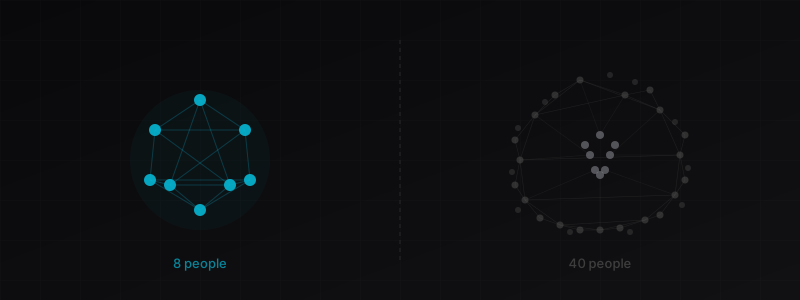
This wasn't a revolutionary insight. Plenty of people have said it. But we kept coming back to it because we kept seeing it everywhere. Teams of forty where eight people did the real work and thirty-two managed the process around those eight. Layers of coordination that existed primarily to coordinate other layers of coordination.
We believed that a small team of experienced people who trust each other and communicate well can outperform teams many times their size. Not on everything, and not forever, but on the kind of focused product work that actually moves the needle.
It was a nice theory. We talked about it a lot. And then we kept going to our day jobs.
The window
What finally turned talk into action was AI.
I want to be careful here because the AI hype cycle is real and I don't want to sound like I'm riding a wave of buzzwords. But the honest truth is that AI fundamentally changed the math on our "small team" thesis.
The argument was always that a small team could compete, but the counterargument was always there too: at some point you need bodies. You need people to write code, design interfaces, handle operations, manage infrastructure, do market research. There's a floor below which you simply can't shrink a team and still ship a real product.
AI moved that floor. Dramatically. A team of one can now do amazing things that took a full team a few years ago.
A lot of what used to require headcount (the mechanical throughput, not the creative and strategic thinking) suddenly became amplifiable in ways that weren't possible before. A developer with AI assistance doesn't just code a little faster. They can operate in a fundamentally different way. The bottleneck shifts from "can we produce enough?" to "do we know what to produce?" That second question favors experienced people with good judgment over large teams with elaborate processes.
The bottleneck shifts from "can we produce enough?" to "do we know what to produce?"
Our decade-old hypothesis wasn't just validated. It was amplified to a degree we hadn't imagined.
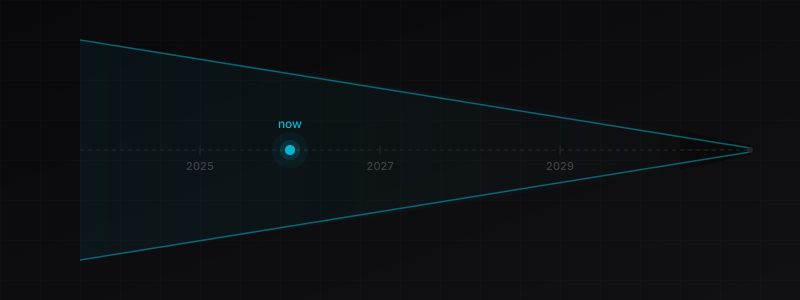
But that alone wasn't enough to get me off the sidelines. What did it was the realization that this window won't stay open forever.
In early 2025, I realized we are in a period, maybe three to five years from then, where the landscape is shifting fast enough that new entrants can compete with established players. The tools are new. The playbooks haven't been written. The incumbents are still figuring out how to adapt, and that adaptation is slow because large organizations are, almost by definition, slow to change. Even people who are fast to adapt are having trouble keeping up with the astonishing pace of progress.
This is the once in a lifetime window. And windows close.
I've lived through enough technology shifts to recognize that the early period of disruption is when new companies get built. Once the dust settles, the advantages consolidate. The big players absorb what works, the tools get commoditized, and the barrier to entry goes back up. If you're going to do it, you do it now.
That urgency is what turned "someday" into "today." Not panic. Just a clear-eyed recognition that timing matters, and the timing needs to be right now.
Burn the boats
In 2025, our group of co-conspirators made a pact: 2026 would be the year of action and the end of excuses. After a holiday break to rest up, we got to work.
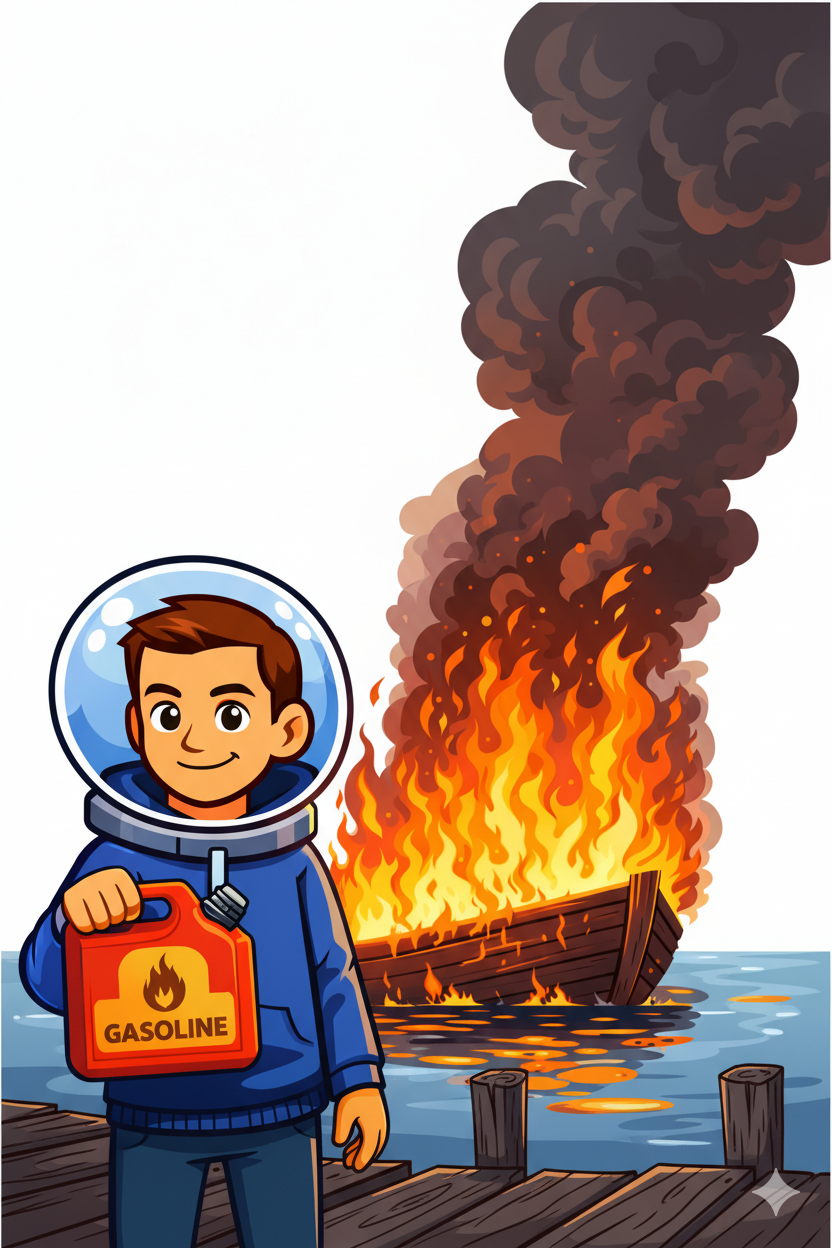
And I don't mean nights-and-weekends got to work. This is our full-time effort, no day job to split our attention or give us a comfortable fallback. Remember the "entrepreneurship with training wheels" I mentioned earlier, the safety net of a steady paycheck underneath? We lit that on fire. Burn the boats, as they say. If we're going to do this, we're going to actually do it. All-out effort, not hedging our bets and dabbling with one foot still in the comfortable world.
I won't pretend the fear is gone. If anything, burning the boats makes it louder. I know outcomes aren't guaranteed. We're building something from nothing, without funding, in a competitive world. Most startups fail, and we know that.
But I'm confident this is the right path at this stage of my life. The alternative, continuing to watch from the sidelines while the biggest technological shift of our careers plays out, feels worse than any failure I can imagine. I'd rather try and fail than spend another decade having the same conversation about what could be. I want to look back and have no regrets about the chances not taken.
I'm also not doing this alone, which matters more than I can express. I've worked with my two partners, built things, debugged things, argued over system designs, in some cases for decades. There's a shorthand and a trust there that you can't manufacture with a random co-founder. When you're building from zero, the people matter more than anything else.
So, why now?
Because the fear of regret finally outweighed the fear of failure. Because a window opened that won't stay open forever. And because at some point, you have to stop talking about it and start building it.
Marc Hanson is a co-founder at Super Mega Lab. He's been building software for over 25 years and in 2026 decided to start building for himself.